

Karijera iz snova: istina ili mit?
 Kata Živković5 min čitanja
Dobro je poznata izreka "Pronađi posao koji voliš i nećeš morati raditi ni dana u životu." Ipak, koliko bi se ljudi s time složilo? Odabir karijere koja bi trebala biti "karijera iz snova" nije lagan posao, a lažu li nas oni koji su rekli da su je pronašli ili ne, saznaj u nastavku.
Što karijera iz snova nije
Mnogi postavljaju pitanje s koliko si godina dovoljno zreo/la da donosiš promišljene odluke o svom profesionalnom putu? Ipak, pravo pitanje bi trebalo biti koliko te sustav usmjerava da promišljaš o svom profesionalnom putu i od najranije dobi? Ali, ovaj članak nije namijenjen kritici obrazovnog sustava.
O snagama, vještinama, onome što ti dobro (ne) ide, ono što voliš i sl. ti govori tvoj profesionalni identitet o kojem uskoro nešto više.
Ako si dovoljno sretan/na da si se kroz razne poslove, rad na sebi i dobra i loša iskustva upoznao/la sa svojim snagama, talentima, izbrusio/la određene vještine, onda barem donekle znamš što bi želio/la raditi ili se tim poslom već i baviš.
Tvoja karijera predstavlja proces tvog profesionalnog razvoja, kroz zvanje, zanimanje, poslovna iskustva i sl.
Karijera iz snova ne znači da ćeš u poslu kojim se baviš voljeti svaki dio, sve zadatke, biti uvijek pun/a energije, nasmijan/a i uspješan/na.
Karijera iz snova, isto tako, ne znači da ti na poslu ponekada nije teško, da ne radiš pogreške, da nemaš iza sebe propale suradnje i ideje.
Štoviše, istraživanja pokazuju da veći uspjeh postižu oni koji su usmjereni na dugoročne ciljeve, a to znači da ih prepreke, neuspjesi i loša iskustva nisu zaustavili. Naprotiv, smatrali su ih sastavnim dijelom iskustva na putu profesionalnog razvoja.

Od profesionalnog identiteta do karijere iz snova
Profesionalni identitet čine osobni stavovi, vrijednosti, iskustva i osjećaj samoefikasnosti s obzirom na profesionalno, ali i šire okruženje. Naš profesionalni identitet bi trebao biti autentičan, prepoznatiljv i dosljedan.
Pojedinci s izgrađenim profesionalnim identitetom pokazuju veće zadovoljstvo, predanost i motivaciju za rad.
U redu je ako nemaš definiran svoj profesionalni identitet. On se kroz životna iskustva oblikuje i gradi. I to znači da je u redu promijeniti posao ako te ne ispunjava.
Tome doprinosi i dobra vijest je da polako napuštamo onaj "mindset" da nam prvi posao mora biti i posljednji.
Gallupova istraživanja pokazuju da su milenijalci (pojedinci rođeni između 1980.-1996.) skloniji mijenjati svoje karijere i organizacije u kojima rade, tražeći ono što je najbolje za njih.
Ono što posebno pomaže u oblikovanju profesionalnog identiteta je postavljanje pravih pitanja.

Da, to su ona pitanja za koja često nemaš vremena jer ti se čine kao besmislica. Tako radije kroz život letiš radeći posao koji ne voliš, ne razmišljajući o tome jesi li ti prava osoba za to, voliš li to uopće, vidiš li ikakvu korist i smisao od toga.
Izbjegavanje tih pitanja dovodi do potpunog gubitka smisla. O logoterapiji kao odličnoj metodi za one koji ne vide smisao u poslu smo pisali u prethodnom blogu.
Budući da je naš profesionalni identitet oblikovan našim vrijednostima, vještinama/snagama, strastima, osobinama ličnosti i iskustvima, onda je definiranje tih sastavnica prvi korak pri oblikovanju karijere iz snova.
Da bi otkrio/la svoju karijeru iz snova moraš oblikovati svoj profesionalni identitet, a to činiš tražeći odgovore na sljedeća pitanja:
- Koje su moje vrijednosti: Što ti je u životu važno? Koje vrijednosti njeguješ?
- Koje su moje vještine/snage: Koje poslove obavljaš s lakoćom? Što drugi prepoznaju da ti ide dobro?
- Poznajem li svoje osobine ličnosti: Voliš li posao obavljati samostalno ili si timski igrač? Jesi li usmjereniji na rješenje problema ili međuljudske odnose?
- Što je moja strast: Što voliš raditi u slobodno vrijeme? Koje su ti teme zanimljive?
- Kakva su moja iskustva: Koja iskustva (privatna i poslovna) su te obogatila dodatnim znanjima i vještinama? Po čemu se ističeš u odnosu na druge?
Odgovori na ta pitanja pomoći će ti približiti se svojoj karijeri iz snova. Također, postoji nekoliko besplatnih upitnika gdje možeš saznati nešto o tome, a jedan kratak je npr:
- Je li Tech industrija za mene- ili ako se svi bave digitalnim marketingom moram li i ja?
Ipak, takvi upitnici u besplatnoj verziji ne davaju detaljne informacije o profesionalnom razvoju.
A više o profesionalnom identitetu, upitniku, vježbi procjene profesionalnih interesa i vještina, možeš proći na jednom od susreta na našoj online edukaciji Akademija osobnog razvoja.
Ikigai kao pomoć u pronalasku karijere iz snova
O Ikigai metodi sretnog življenja pisali smo u prethodnom blogu. Ikigai potječe od japanske riječi IKI (život) i GAI (svrha). Onaj tko je pronašao svoj Ikigai, vrlo vjerojatno je pronašao i svoju karijeru iz snova.

U kontekstu našeg profesionalnog razvoja, Ikigai nam pomaže definirati 4 ključna elementa. To su profesija, poziv, strast i misija koje otkrivamo kroz:
- ono što voliš
- ono što je svijetu potrebno
- ono za što možeš biti plaćen/a
- ono u čemu si dobar/ra.
Ono što se većini ljudi događa je da su pronašli samo neke od 4 elementa.
Npr: Ako radiš nešto za što si plaćen, ide ti dobro i svijetu je potrebno, ali ne voliš to što radiš – borit ćeš se s osjećajem praznine.
Isto tako, ako radiš nešto što voliš, što je svijetu potrebno, ali ti ne ide dobro – borit ćeš se s osjećajem nedostatnosti i većinu vremena biti pod stresom.
Ikigai se nalazi u središtu sva 4 elementa, a snažan je pokazatelj koliko si blizu svojoj karijeri iz snova.
Karijera iz snova ipak nije mit
Zaključno, karijera iz snova ipak nije mit, ali nije ni učestala pojava.
Istraživanja pokazuju da je manje od 15% zaposlenih strastveno u vezi svog posla.
Taj je podatak prilično poražavajući, stoga i ne čudi što na karijeru iz snova gledamo kao na, upravo to, samo san.
Ipak, koliko god nizak postotak bio, sigurno u svom radu primjećuješ one koji su iznimno strastveni oko svoje karijere i to prenose na svoje zaposlenike i okruženje. Takvim se ljudima, koliko je moguće treba okružiti, a njihovim pričama inspirirati.
Oni koji su pronašli karijeru iz snova savjetovat će ti što i mi: ne boj se postavljati pitanja sebi i drugima, a na pogreške i neuspjeh gledaj kao na priliku za rast.
______________________
Želiš naučiti više o odabiru karijere iz snova i upoznati se s ključnim temama za tvoj osobni razvoj? Na pravom si mjestu!
Još s bloga
Sve objave
Čitanje u svakoj dobi: kako ponovno pronaći vrijeme za knjigu?
Koliko si puta rekao da nemaš vremena za čitanje? Knjiga čeka na polici, ti pogledaš naslovnicu i pomisliš: „Pročitat ću je kad uhvatim malo vremena.
More Than Money: Why Financial Literacy Is a Democratic Competence
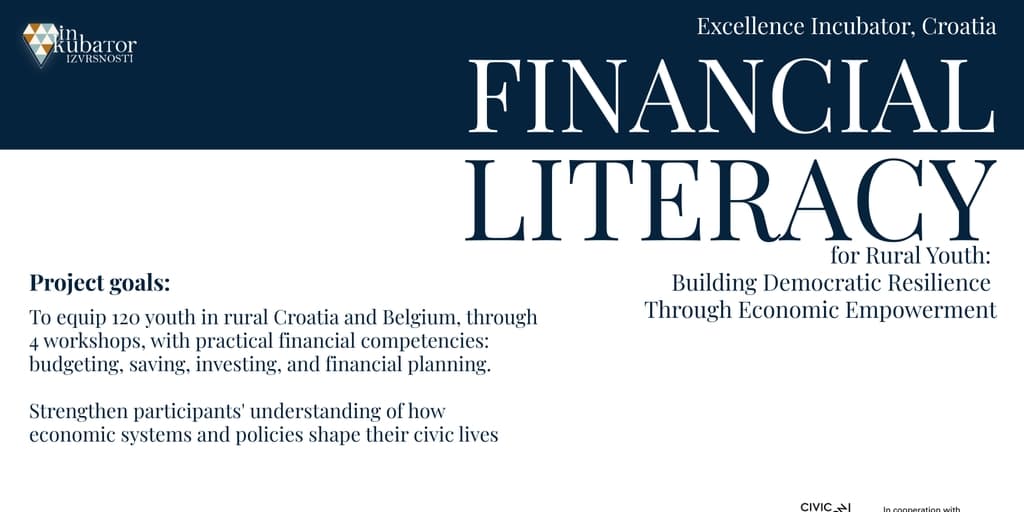
Reflections from the Financial and Economic Literacy NECE Lab, Vienna, 27–28 April 2026 When we talk about financial literacy, most people picture budgeting apps, savings accounts, and the fine print on a loan agreement. Useful things, but a narrow picture. Increasingly, educators, researchers, and policymakers across Europe are making a bigger claim: understanding money is not only a personal survival skill. It is a foundation of active citizenship and democratic resilience. That claim was the beating heart of the Financial and Economic Literacy NECE Lab in Vienna, a two-day gathering hosted by THE CIVICS Innovation Hub together with Znanje na djelu and the Erste Financial Life Park (FLiP), with the support of ERSTE Foundation. We were proud to be part of it, having Magdalena Basić Alando actively participate and present our own project, Financial Literacy for Rural Youth, and learning alongside practitioners from across the continent. This post pulls together what the research actually says, and what we saw play out in the room. The problem: too many young people can't apply what they know Start with the evidence. In the OECD's most recent international assessment of 15-year-olds, released in 2024, the picture is sobering: across the 14 OECD countries assessed, 18% of students on average do not have basic proficiency in financial literacy, meaning they cannot apply their knowledge to real-life situations involving financial decisions. The gap is not evenly distributed. Socio-economically disadvantaged students are over-represented among low performers, which risks entrenching inequality as those students become adults. In other words, the young people who most need economic confidence are the ones least likely to be given it — a pattern that maps neatly onto who feels shut out of public life more broadly. There is a hopeful flip side. Financial literacy and positive financial behaviour are linked: students with stronger skills behave more responsibly with money and are more forward-looking, with high performers markedly more likely than low performers to save. Skills, attitudes, and behaviour move together — which is exactly why how we teach matters as much as what we teach. The bigger claim: financial literacy feeds democratic participation Here is where the Vienna conversation went beyond personal finance. One of the Lab's expert speakers was Anna Lo Prete of the University of Turin, whose research sits right at this intersection — and whose work is among the clearest evidence we have on the question. Lo Prete's cross-country analysis documents a positive association between political participation — measured by the number of citizens voting in national elections — and the awareness of the trade-offs behind private and public decisions that basic financial education captures. Crucially, this is not just correlation dressed up: empirical models that control for a large set of other determinants of voter turnout indicate that financial literacy continues to have a positive and causal impact on electoral participation. Why would that be? The logic is intuitive once you see it. Understanding some economics and finance helps citizens grasp the reasons behind public intervention and weigh the pros and cons of policy proposals and agendas. A voter who understands taxation, public budgets, inflation, and debt is simply better equipped to evaluate the promises on a ballot — and harder to mislead. The catch: financial literacy alone isn't enough It would be too easy to conclude "teach kids about compound interest and democracy takes care of itself." The research is more demanding than that — and this nuance came up repeatedly in Vienna's group work. A recurring critique in the academic literature is that much mainstream financial education quietly frames citizens as consumers rather than participants. One influential analysis argues that dominant financial literacy programmes can end up promoting a limited, consumerist form of civic engagement, and that what is really needed is a critical, emancipatory civic financial literacy for an engaged citizenry able to extend and protect more robust conceptions of freedom and democracy. Scholars working on integrative economic education put the point sharply: financial literacy without civic competence remains a merely reactive skill rather than a source of genuine political agency, which is why financial literacy and civic competences should be understood as parts of a single integrative concept of economic education. The two only reach their full value when taught together — money knowledge that can read the system, not just cope with it. Europe is building the scaffolding None of this is happening in a vacuum. The policy architecture is catching up with the research. In 2023 the European Commission and the OECD jointly published a Financial Competence Framework for Children and Youth in the European Union. It is not only about interest rates and risk: alongside the four core content areas — money and transactions, planning and managing finances, risk and reward, and the financial landscape — the framework deliberately integrates cross-cutting dimensions including digital finance, sustainable finance, entrepreneurship, and citizenship. Citizenship is written into the framework by design. On the civic side, the Council of Europe's Reference Framework of Competences for Democratic Culture exists precisely to equip young people with the competences needed to defend and promote human rights, democracy and the rule of law, to act as active citizens, and to live peacefully together with others. Read the two frameworks side by side and the overlap is obvious: critical thinking, informed decision-making, and the confidence to participate. What this looks like in practice: rural youth and economic autonomy This is the gap our own project set out to close, and the reason we were presenting it in Vienna. Financial Literacy for Rural Youth: Building Democratic Resilience Through Economic Empowerment merges financial and civic education for an audience usually left out of both: young people in rural areas, who are systematically underrepresented in programmes that tend to be urban-centred. Working with our partners, the project equips rural GenZ participants in Croatia and Belgium with practical competences: budgeting, saving, investing, planning; through gamified, peer-to-peer, blended learning adapted to rural digital realities. But the design goes a step past personal finance, exactly along the lines the research recommends. Participants learn to analyse economic policies, financial products, and media narratives about money, so they can resist manipulation and make informed civic choices. The premise is that economic dependency and exclusion are themselves barriers to democratic participation, and that when young people understand how taxation, public budgets, and economic policy shape their own lives, they engage more meaningfully in democratic processes. A transnational peer exchange between Croatian and Belgian participants adds a cross-cultural, shared-European dimension, a small counterweight to the polarisation that tends to follow economic marginalisation. The pilot trainings in Croatia are already complete, with workshops in Belgium still ahead. And the methodology is being built to outlast the project and be shared amongst all stakeholders. Where the formal and non-formal worlds meet If there was one moment in Vienna that made the abstract concrete, it was the guided tour of the Erste Financial Life Park (FLiP), FLiP turns financial education into something you can walk through and touch: interactive stations where visitors make real-feeling budgeting decisions and immediately see the consequences. It is a vivid rebuttal to the idea that money education has to be dry. A theme the NECE Lab kept returning to, and one the research underlines, is the relationship between formal schooling and non-formal education. Classrooms provide reach and legitimacy; non-formal initiatives like ours provide the agility to reach underserved groups, experiment with gamified and peer-led methods, and adapt fast. The most promising path forward is not one or the other, but connective tissue between them: school systems that borrow the energy of non-formal approaches, and civic organisations whose toolkits can be picked up and used inside classrooms. The takeaway The case made in Vienna, and backed by the evidence, is straightforward but consequential. Financial literacy is not merely about helping individuals stay solvent. Done well, paired with civic competence rather than reduced to consumer advice, it strengthens people's capacity to understand the systems they live in, to resist manipulation, and to participate in the democratic decisions that shape their economic lives. In an era of rising costs, growing inequality, and declining trust in institutions, that capacity is not a luxury. It is infrastructure for democracy. We left Vienna grateful to all speakers for the intellectual grounding; to our fellow educators for the knowledge exchange and the good company; to the organisers: THE CIVICS Innovation Hub, Znanje na djelu, Erste Financial Life Park, and ERSTE Foundation, FLiP centre. The next chapter is being written in rural classrooms and community halls across Europe. We're glad to be part of it. Sources OECD (2024), PISA 2022 Results (Volume IV): How Financially Smart Are Students?, OECD Publishing. Lo Prete, A. (2024), Political participation and financial education: Understanding personal and collective trade-offs for a better citizenship, Economics Letters / ScienceDirect. Lo Prete, A., Financial education: From better personal finance to improved citizenship, Journal of Financial Literacy and Wellbeing, Cambridge Core. Arthur, C. (2012), Financial Literacy Education for Citizens: What Kind of Responsibility, Equality and Engagement?, Citizenship, Social and Economics Education (SAGE). Integrative Economic Education to Combine Citizenship Education and Financial Literacy (ResearchGate). European Union / OECD (2023), Financial Competence Framework for Children and Youth in the European Union, OECD Publishing. Council of Europe, Reference Framework of Competences for Democratic Culture (RFCDC).

Životni skript: zašto ponavljaš iste obrasce i kako ih promijeniti?
Jesi li ikad primijetio/la da u različitim vezama završavaš s istim tipom problema? Ili da na poslu uvijek ulazi u istu vrstu sukoba --- bez obzira...
