

Čitanje u svakoj dobi: kako ponovno pronaći vrijeme za knjigu?
Koliko si puta rekao da nemaš vremena za čitanje? Knjiga čeka na polici, ti pogledaš naslovnicu i pomisliš: „Pročitat ću je kad uhvatim malo vremena.“ A onda prođu dani, tjedni, ponekad i mjeseci.
Kao knjižničarka, tu rečenicu čujem često. Od djece, roditelja, zaposlenih ljudi, studenata pa sve do umirovljenika. I zato znam da problem najčešće nije u tome što ne voliš knjige. Problem je što si zaboravio koliko ti čitanje može dati.
Imaš li doista premalo vremena za čitanje?
Živiš brzo. Posao, obitelj, obaveze, telefon, poruke, društvene mreže. Kad napokon sjedneš, najlakše je posegnuti za ekranom.
Knjiga traži nešto drugo. Traži da zastaneš.
Ali ne moraš odmah pročitati pedeset stranica. Ne moraš završiti knjigu za vikend. Dovoljno je početi s deset minuta dnevno.
Čitanje nije natjecanje.
To je vrijeme koje daješ sebi.
Istraživanja pokazuju da upravo čitanje iz užitka ima važnu povezanost s čitalačkim sposobnostima. OECD je u analizama PISA istraživanja utvrdio pozitivnu povezanost uživanja u čitanju i uspjeha u čitanju među učenicima. Važno je i to da OECD ističe povezanost čitalačkih navika, motivacije i čitalačke sposobnosti kod odraslih.
Drugim riječima, ne moraš čitati zato da bi bio „bolji čitatelj“. Čitaj zato što ti knjiga nešto daje. Vještina dolazi zajedno s navikom.
Što ti knjiga može dati u različitim životnim razdobljima?
Ne treba ti ista knjiga u dvadesetoj, četrdesetoj ili sedamdesetoj godini.
Kao što se mijenjaš ti, mijenja se i ono što tražiš od knjige.
Ako si dijete, knjiga ti otvara prvi veliki svijet izvan onoga koji poznaješ. Slikovnica ti pomaže imenovati osjećaje. Priča ti pokazuje da netko drugi može biti hrabar, uplašen, usamljen ili sretan baš kao ti.
Istraživanje Hei Wan Mak i Daisy Fancourt pratilo je 8.936 djece u dobi od sedam do jedanaest godina. Autori su pronašli povezanost svakodnevnog čitanja iz užitka u dobi od sedam godina s boljim prosocijalnim ponašanjem te nižim razinama hiperaktivnosti, nepažnje i emocionalnih problema u dobi od jedanaest godina.
To ne znači da će knjiga riješiti svaki dječji problem. Ali pokazuje koliko čitalačke navike mogu biti vrijedan dio odrastanja.
Ako si tinejdžer, knjiga ti može pomoći da bolje razumiješ sebe. U njoj možeš pronaći lik koji se osjeća kao ti. Ili upravo suprotno – nekoga potpuno različitog od tebe.
A to je jedna od najljepših stvari koje ti književnost može ponuditi: mogućnost da na trenutak pogledaš svijet tuđim očima.
Ako si odrasla osoba, knjiga ti može biti predah. Ne mora uvijek biti korisna. Ne moraš iz nje nešto „izvući“.
Ponekad je dovoljno da te nasmije.
Ponekad da te rastuži.
Ponekad da ti na sat vremena odvuče misli od onoga što te cijeli dan opterećivalo.
Ako si u mirovini, knjiga ti može otvoriti nove teme, vratiti uspomene ili jednostavno ispuniti dio dana koji je odjednom postao tiši.
Zato nemoj misliti da je za knjigu „prošlo vrijeme“.
Za knjigu nikad nije kasno.
Ne znaš što čitati? Počni od sebe.
Jedna od najčešćih rečenica koju čujem u knjižnici jest: „Preporučite mi nešto.“
Volim to pitanje.
Ali prije preporuke obično postavim nekoliko svojih.
o Što si zadnje pročitao i svidjelo ti se?
o Želiš li nešto lagano ili ozbiljno?
o Želiš li priču koja će te nasmijati ili onu koja će te natjerati na razmišljanje?
o Koliko vremena imaš za čitanje?
o Postoji li tema o kojoj već dugo želiš nešto saznati?
Jer ne postoji jedna dobra knjiga za sve.
Postoji dobra knjiga za tebe – sada.
To je možda i najvažnija uloga knjižnice. Ne samo čuvati knjige, nego pomoći ljudima da pronađu onu pravu.
A što ako si izgubio naviku čitanja?
Nemoj odmah posegnuti za najdebljom knjigom koju pronađeš.
Vrati se polako.
Pokušaj ovako:
o Čitaj deset minuta dnevno.
o Odaberi knjigu koja te stvarno zanima.
o Nemoj se bojati odustati od knjige koja ti ne odgovara.
o Drži knjigu na mjestu koje često vidiš.
o Uvedi mali ritual – kava i nekoliko stranica, knjiga prije spavanja ili čitanje tijekom vožnje javnim prijevozom.
I zapamti: knjiga koju ne završiš nije neuspjeh.
Možda samo nije bila prava knjiga za tebe.
Zašto nam je čitanje danas možda važnije nego ikad?
Danas smo okruženi tekstom. Čitamo poruke, vijesti, komentare, upute, oglase i objave. Ali brzo čitanje nije isto što i razumijevanje pročitanoga.
OECD čitalačku pismenost definira kao sposobnost razumijevanja, korištenja, vrednovanja i promišljanja o tekstovima. Danas to uključuje i snalaženje u digitalnom okruženju, uspoređivanje različitih izvora te razlikovanje činjenica od mišljenja.
To je posebno važno u vremenu kada svakoga dana primamo ogromnu količinu informacija.
Knjiga te uči usporiti.
Uči te pratiti misao. Povezivati informacije. Postavljati pitanja. Prepoznati nijanse.
A književnost ti daje još nešto.
Daje ti druge ljude.
Virginia Woolf u eseju How Should One Read a Book? piše o čitanju kao aktivnosti koja traži slobodu i vlastiti izbor. Upravo je to važno i danas. Ne moraš čitati ono što drugi očekuju od tebe. Pronađi ono što te zanima.
I zato bih voljela da na čitanje ne gledaš kao na još jednu obavezu.
Ne moraš pročitati 50 knjiga godišnje.
Ne moraš čitati svaki dan.
Ne moraš čitati ono što svi čitaju.
Samo pronađi knjigu kojoj ćeš poželjeti okrenuti sljedeću stranicu.
Možda ćeš tako ponovno otkriti nešto što si negdje putem izgubio – nekoliko minuta mira, novu ideju, zanimljiv razgovor ili jednostavno osjećaj da si negdje drugdje.
A ako ne znaš odakle početi, dođi u knjižnicu.
Mi knjižničari imamo vremena za takva pitanja.
I vrlo često imamo knjigu koja čeka baš tebe.
Izvori podataka:
[1] OECD (2011). Do Students Today Read for Pleasure? PISA in Focus, No. 8. OECD Publishing, Paris. DOI: 10.1787/5k9h362lhw32-en.
Istraživanje i analiza PISA podataka o čitanju iz užitka, čitalačkim navikama, motivaciji i uspjehu u čitanju.
[2] Mak, H. W. & Fancourt, D. (2020). Longitudinal associations between reading for pleasure and child maladjustment: Results from a propensity score matching analysis. Social Science & Medicine, 253, 112971. DOI: 10.1016/j.socscimed.2020.112971.
Longitudinalno istraživanje provedeno na 8.936 djece koje je pratilo povezanost čitanja iz užitka i kasnije psihološke i ponašajne prilagodbe.
[3] OECD. Reading literacy. OECD – Education and Skills.
Izvor za suvremeno određenje čitalačke pismenosti i podatke o povezanosti uživanja u čitanju i čitalačkog uspjeha u istraživanju PISA.
Književni izvor:
Woolf, Virginia (1926). How Should One Read a Book? Esej iz zbirke The Common Reader: Second Series.
Još s bloga
Sve objave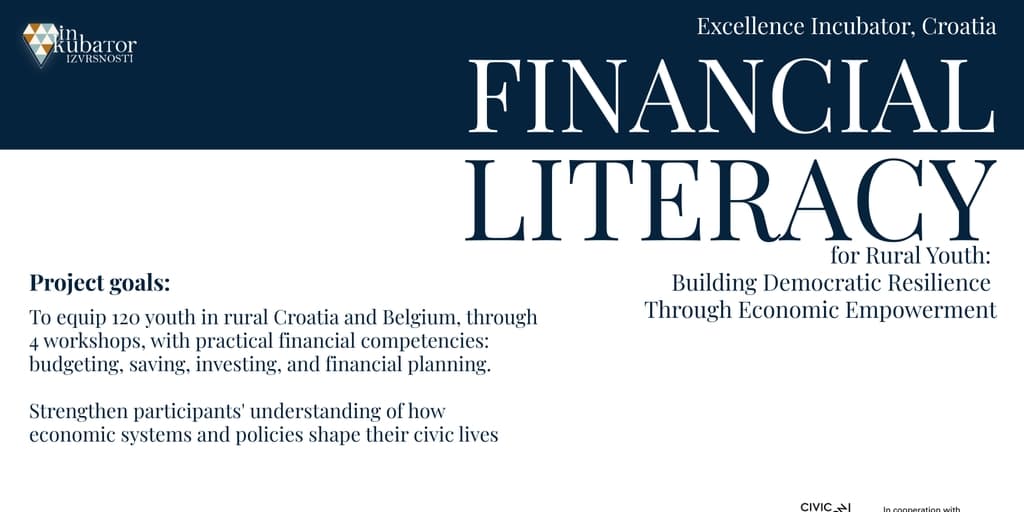
More Than Money: Why Financial Literacy Is a Democratic Competence
Reflections from the Financial and Economic Literacy NECE Lab, Vienna, 27–28 April 2026 When we talk about financial literacy, most people picture budgeting apps, savings accounts, and the fine print on a loan agreement. Useful things, but a narrow picture. Increasingly, educators, researchers, and policymakers across Europe are making a bigger claim: understanding money is not only a personal survival skill. It is a foundation of active citizenship and democratic resilience. That claim was the beating heart of the Financial and Economic Literacy NECE Lab in Vienna, a two-day gathering hosted by THE CIVICS Innovation Hub together with Znanje na djelu and the Erste Financial Life Park (FLiP), with the support of ERSTE Foundation. We were proud to be part of it, having Magdalena Basić Alando actively participate and present our own project, Financial Literacy for Rural Youth, and learning alongside practitioners from across the continent. This post pulls together what the research actually says, and what we saw play out in the room. The problem: too many young people can't apply what they know Start with the evidence. In the OECD's most recent international assessment of 15-year-olds, released in 2024, the picture is sobering: across the 14 OECD countries assessed, 18% of students on average do not have basic proficiency in financial literacy, meaning they cannot apply their knowledge to real-life situations involving financial decisions. The gap is not evenly distributed. Socio-economically disadvantaged students are over-represented among low performers, which risks entrenching inequality as those students become adults. In other words, the young people who most need economic confidence are the ones least likely to be given it — a pattern that maps neatly onto who feels shut out of public life more broadly. There is a hopeful flip side. Financial literacy and positive financial behaviour are linked: students with stronger skills behave more responsibly with money and are more forward-looking, with high performers markedly more likely than low performers to save. Skills, attitudes, and behaviour move together — which is exactly why how we teach matters as much as what we teach. The bigger claim: financial literacy feeds democratic participation Here is where the Vienna conversation went beyond personal finance. One of the Lab's expert speakers was Anna Lo Prete of the University of Turin, whose research sits right at this intersection — and whose work is among the clearest evidence we have on the question. Lo Prete's cross-country analysis documents a positive association between political participation — measured by the number of citizens voting in national elections — and the awareness of the trade-offs behind private and public decisions that basic financial education captures. Crucially, this is not just correlation dressed up: empirical models that control for a large set of other determinants of voter turnout indicate that financial literacy continues to have a positive and causal impact on electoral participation. Why would that be? The logic is intuitive once you see it. Understanding some economics and finance helps citizens grasp the reasons behind public intervention and weigh the pros and cons of policy proposals and agendas. A voter who understands taxation, public budgets, inflation, and debt is simply better equipped to evaluate the promises on a ballot — and harder to mislead. The catch: financial literacy alone isn't enough It would be too easy to conclude "teach kids about compound interest and democracy takes care of itself." The research is more demanding than that — and this nuance came up repeatedly in Vienna's group work. A recurring critique in the academic literature is that much mainstream financial education quietly frames citizens as consumers rather than participants. One influential analysis argues that dominant financial literacy programmes can end up promoting a limited, consumerist form of civic engagement, and that what is really needed is a critical, emancipatory civic financial literacy for an engaged citizenry able to extend and protect more robust conceptions of freedom and democracy. Scholars working on integrative economic education put the point sharply: financial literacy without civic competence remains a merely reactive skill rather than a source of genuine political agency, which is why financial literacy and civic competences should be understood as parts of a single integrative concept of economic education. The two only reach their full value when taught together — money knowledge that can read the system, not just cope with it. Europe is building the scaffolding None of this is happening in a vacuum. The policy architecture is catching up with the research. In 2023 the European Commission and the OECD jointly published a Financial Competence Framework for Children and Youth in the European Union. It is not only about interest rates and risk: alongside the four core content areas — money and transactions, planning and managing finances, risk and reward, and the financial landscape — the framework deliberately integrates cross-cutting dimensions including digital finance, sustainable finance, entrepreneurship, and citizenship. Citizenship is written into the framework by design. On the civic side, the Council of Europe's Reference Framework of Competences for Democratic Culture exists precisely to equip young people with the competences needed to defend and promote human rights, democracy and the rule of law, to act as active citizens, and to live peacefully together with others. Read the two frameworks side by side and the overlap is obvious: critical thinking, informed decision-making, and the confidence to participate. What this looks like in practice: rural youth and economic autonomy This is the gap our own project set out to close, and the reason we were presenting it in Vienna. Financial Literacy for Rural Youth: Building Democratic Resilience Through Economic Empowerment merges financial and civic education for an audience usually left out of both: young people in rural areas, who are systematically underrepresented in programmes that tend to be urban-centred. Working with our partners, the project equips rural GenZ participants in Croatia and Belgium with practical competences: budgeting, saving, investing, planning; through gamified, peer-to-peer, blended learning adapted to rural digital realities. But the design goes a step past personal finance, exactly along the lines the research recommends. Participants learn to analyse economic policies, financial products, and media narratives about money, so they can resist manipulation and make informed civic choices. The premise is that economic dependency and exclusion are themselves barriers to democratic participation, and that when young people understand how taxation, public budgets, and economic policy shape their own lives, they engage more meaningfully in democratic processes. A transnational peer exchange between Croatian and Belgian participants adds a cross-cultural, shared-European dimension, a small counterweight to the polarisation that tends to follow economic marginalisation. The pilot trainings in Croatia are already complete, with workshops in Belgium still ahead. And the methodology is being built to outlast the project and be shared amongst all stakeholders. Where the formal and non-formal worlds meet If there was one moment in Vienna that made the abstract concrete, it was the guided tour of the Erste Financial Life Park (FLiP), FLiP turns financial education into something you can walk through and touch: interactive stations where visitors make real-feeling budgeting decisions and immediately see the consequences. It is a vivid rebuttal to the idea that money education has to be dry. A theme the NECE Lab kept returning to, and one the research underlines, is the relationship between formal schooling and non-formal education. Classrooms provide reach and legitimacy; non-formal initiatives like ours provide the agility to reach underserved groups, experiment with gamified and peer-led methods, and adapt fast. The most promising path forward is not one or the other, but connective tissue between them: school systems that borrow the energy of non-formal approaches, and civic organisations whose toolkits can be picked up and used inside classrooms. The takeaway The case made in Vienna, and backed by the evidence, is straightforward but consequential. Financial literacy is not merely about helping individuals stay solvent. Done well, paired with civic competence rather than reduced to consumer advice, it strengthens people's capacity to understand the systems they live in, to resist manipulation, and to participate in the democratic decisions that shape their economic lives. In an era of rising costs, growing inequality, and declining trust in institutions, that capacity is not a luxury. It is infrastructure for democracy. We left Vienna grateful to all speakers for the intellectual grounding; to our fellow educators for the knowledge exchange and the good company; to the organisers: THE CIVICS Innovation Hub, Znanje na djelu, Erste Financial Life Park, and ERSTE Foundation, FLiP centre. The next chapter is being written in rural classrooms and community halls across Europe. We're glad to be part of it. Sources OECD (2024), PISA 2022 Results (Volume IV): How Financially Smart Are Students?, OECD Publishing. Lo Prete, A. (2024), Political participation and financial education: Understanding personal and collective trade-offs for a better citizenship, Economics Letters / ScienceDirect. Lo Prete, A., Financial education: From better personal finance to improved citizenship, Journal of Financial Literacy and Wellbeing, Cambridge Core. Arthur, C. (2012), Financial Literacy Education for Citizens: What Kind of Responsibility, Equality and Engagement?, Citizenship, Social and Economics Education (SAGE). Integrative Economic Education to Combine Citizenship Education and Financial Literacy (ResearchGate). European Union / OECD (2023), Financial Competence Framework for Children and Youth in the European Union, OECD Publishing. Council of Europe, Reference Framework of Competences for Democratic Culture (RFCDC).

Životni skript: zašto ponavljaš iste obrasce i kako ih promijeniti?
Jesi li ikad primijetio/la da u različitim vezama završavaš s istim tipom problema? Ili da na poslu uvijek ulazi u istu vrstu sukoba --- bez obzira...


Toksična komunikacija: 4 tehnike kako se zaštititi bez ulaska u konflikt
Statistike su prilično jasne — 75 % zaposlenih je u svom životu iskusilo toksično radno okruženje. Važno je znati se zaštititi.