
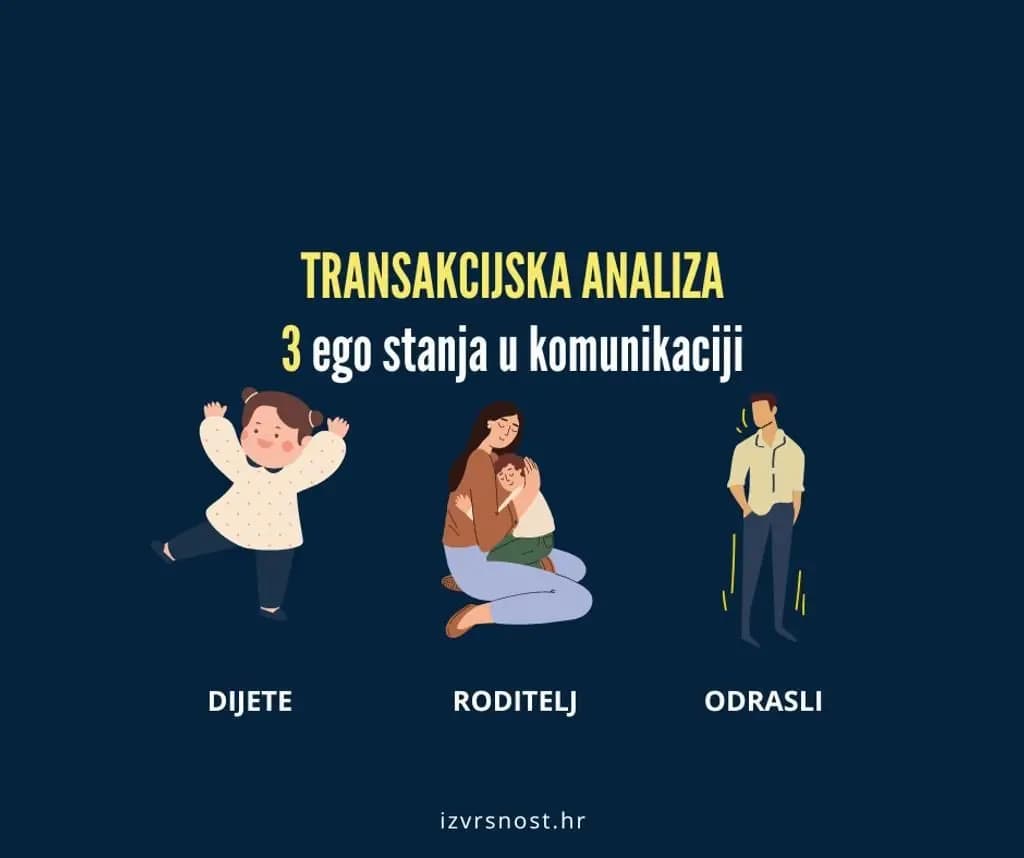
Transakcijska analiza kako naša ego stanja utječu na komunikaciju s drugima?
 Kata Živković6 min čitanja
Transakcijska analiza je psihoterapijski pravac koji nam pomaže razumjeti sebe i ljude koji nas okružuju. U nastavku otkrij kako nam tri ego stanja (Roditelj, Odrasli i Dijete) iz kojih najčešće komuniciramo, mogu olakšati i/ili otežati odnose i što možemo učiniti.
U sklopu online edukacije Komunikacijske vještine, dipl. psihologinja Kristina Bačkonja iz Centra Budi svoj i jedna od predavačica na edukaciji, donosi izvrstan članak o Transakcijskoj analizi.
Nastanak Transakcijske analize
Transakcijska analiza (TA) je psihoterapijski pravac koji je osmislio Eric Berne 1968. godine. Njegova ideja je bila da se naša ličnost može objasniti kroz 3 ego stanja: Dijete, Roditelj, Odrasli, kao i da sve naše transakcije u komunikaciji idu iz nekog od ovih ego stanja. Ta nas ego stanja vode u više ili manje konstruktivnom smjeru.
Tri ego stanja
Tri ego stanja (Dijete, Roditelj, Odrasli), nam zapravo govore jesu li naše trenutne misli, osjećaji i ponašanja kopija roditeljskih, naš povratak u djetinjstvo ili su pak adekvatni u trenutnoj situaciji. Što to točno znači?

Nekada ste se sigurno našli u situaciji kada ste se osjećali, mislili i ponašali kao kada ste bili dijete, iako ste sada već debelo zašli u odraslu dob.
Ako ste primjerice na poslu i šef vas prozove jeste li odradili jedan zadatak (a vi ste zaista zaboravili), u tom trenutku možete se opet osjećati kao kada vas je profesor u školi prozvao da donesete zadaću koju niste imali. Tada se možete zacrvenjeti, početi zamuckivati i opravdavati se zašto niste odradili zadatak. Drugim riječima, vaša reakcija je identična onoj kada ste imali 10 godina. To znači da ste nastupili iz ego stanja Dijete.
Vaš je šef možda u tom trenutku bio u svom ego stanju Roditelja: njegova prozivka i geste koje je pritom koristio mogu biti identične gesti i komunikaciji koju je imao njegov tata kada je provjeravao njega i braću jesu li odradili sve zadatke u kući. Reakcija Odraslog u ovoj situaciji sigurno ne bi bila crvenjenje i opravdavanje. Odrasli bi zaključio da nije odradio zadatak, da je zaboravio, ispričao bi se i potom odradio zadatak u novom roku.
Iako ovaj primjer zvuči kao da je reakcija Odraslog jedina ispravna i poželjna u svim situacijama, to nije tako.
Često nam je Odrasli neophodan da bismo mogli adekvatno komunicirati s drugim odraslim ljudima, no nekada je poželjno opet imati 10 godina ili kopirati naše roditelje. U slučaju tri ego stanja: sve ovisi o kontekstu.
Dijete - Roditelj
Uzmimo za primjer da ste s djetetom (pravim) u parku. Dijete se želi igrati lovice s vama ili pak želi da se skupa ljuljate. Vjerujem da bi djetetu (a i vama) moglo biti puno zabavnije ako oslobodite svoje Dijete da se poigra.
Ako se uživite u ulogu djeteta i zaista igrate lovice kao da vam je opet 7 godina, svi će uživati. Ali ako igrate lovice iz Roditelja koji će vidjeti sve potencijalne prijetnje na koje bi se vaše pravo dijete moglo spotaknuti i pasti, tada više nije zabavno.
Vaše pravo dijete će za igru uvijek više voljeti vaše pozitivno slobodno Dijete.
Pozitivno i negativno Dijete
Znači li da je uvijek potrebno osloboditi Dijete u sebi? Apsolutno ne. Postoji razlika između pozitivno i negativno slobodnog Djeteta.
Dijete (ego stanje) se nekada ne ponaša lijepo. Baš kao i prava djeca. Nekada po gradu vozi 100 km/h, unatoč ograničenju i činjenici da time riskira svoj i/ili tuđe živote.
To negativno slobodno Dijete može biti jako egocentrično, ne uvažavati druge i misliti samo na sebe. Takve reakcije zapravo nisu poželjne i u odrasloj dobi mogu uzrokovati velike probleme u odnosu s drugima.
U odnosu s nadređenima poželjno je naše pozitivno adaptirano Dijete. Ono će se adaptirati i poslušati zahtjeve svog šefa, u slučaju da su ti zahtjevi u redu. Pozitivno adaptirano dijete će i čekati svoj red na blagajni, kod liječnika i slično. Negativno adaptirano Dijete će poslušati sve, čak i u situaciji kada mu autoritet želi nauditi.
Ono će se povući i pokoriti. U slučaju da je odrasla osoba žrtva zlostavljanja i dopušta da se netko nad njim iživljava, postoji velika vjerojatnost da je u stanju negativno adaptiranog i preposlušnog Djeteta.
Preposlušni možemo biti i kada primjerice naš partner izabere film u kinu koji mi nikako ne želimo gledati, ali šutimo. Prevelika poslušnost zapravo nije dobra za nas.
Pozitivan i negativan Roditelj
Kada smo bolesni ili tužni, naš partner nas može njegovati baš kao što su nas nekada njegovali roditelji. Ako nam partner kuha juhu i topli čaj, pokriva nas dekom i provjerava imamo li temperaturu, postoji velika vjerojatnost da nastupa iz stanja pozitivnog njegujućeg Roditelja. On nam treba kada smo bolesni, kada nam je teško, kada nas treba ohrabriti i bodriti.
Druga medalja ovog njegovanja je kada je ono pretjerano i nekonstruktivno.
Primjerice, ako se naša dobra prijateljica jako udebljala, a mi joj nosimo čokoladu i tješimo je da izgleda super (iako smo svjesni da to nije dobro za nju), tada smo u negativnom njegujućem Roditelju.
Ako preuzimamo sve poslovne obaveze od svojih podređenih, štedeći njih i dopuštajući im da ne rade ništa, opet smo u negativnom njegujućem Roditelju. Ova pozicija ponekada može biti jako iscrpljujuća za osobu.
Osoba koja daje dobre, konstruktivne kritike sigurno je u pozitivnom kritičkom Roditelju. Ona služi kao orijentir, ograničava ono što nije u redu i usmjerava. No taj kritičar nekada to može činiti i neprimjereno, udarajući na nečiji identitet, vrijeđajući ili pak osuđujući druge. To je negativni kritički Roditelj.
Ako prezrivo pogledamo kolegicu u uredu koja je upravo napuhala veliki balon od žvakaće gume, vjerojatno smo u negativnom kritičkom Roditelju, a ona u Djetetu.

Dijete-Roditelj-Odrasli
Ako smo primjetili da se kolegica upisala u isto vrijeme za godišnji odmor kada i mi, možemo je otići „tužiti“ šefu i podmetnuti joj klip (negativno slobodno Dijete).
Možemo otići kod kolegice i prozvati je kuda je gledala kada se upisavala i zašto opet svima radi probleme (negativni kritički Roditelj).
A možemo i jednostavno otići do nje, reći da smo primjetili da se upisala u isto vrijeme i provjeriti je li to slučajno ili joj je važno da baš u to vrijeme ide na godišnji (Odrasli).
Odrasli će reagirati adekvatno u tom trenutku, neće zaključivati bez informacija i pretpostavljati bez provjere. On se isto može naljutiti, ali ta je ljutnja adekvatna u toj situaciji, ona ne traje dugo i usmjerava se na rješenje problema.
Transakcijska analiza za zdrave odnose
Poznavanje ego stanja i reakcija iz njih u međuljudskim odnosima može znatno olakšati komunikaciju s drugim ljudima. Kada prepoznamo svoje reakcije i sklonost da „upadnemo“ u određeno ego stanje, lakše ćemo se iz istoga izvući.
S druge strane, kada prepoznamo te stvari i kod drugih ljudi, možemo ujedno i testirati koja naša reakcija (ili promjena reakcije) će izazvati promjenu i kod njih.
Transakcijska analiza zaista nudi jednostavan alat kako bismo život učinili lakšim. Na nama je naučiti rukovati njime.
Kristina Bačkonja, Centar Budi svoj
_______________
Ako želiš naučiti više o osnovama Transakcijske analize, otkriti svoj komunikacijski stil, prepoznati neverbalnu komunikaciju, asertivno komunicirati i prepoznati svoj jezik i jezike ljubavi drugih i još puno toga, na pravom si mjestu.
Još s bloga
Sve objave
Čitanje u svakoj dobi: kako ponovno pronaći vrijeme za knjigu?
Koliko si puta rekao da nemaš vremena za čitanje? Knjiga čeka na polici, ti pogledaš naslovnicu i pomisliš: „Pročitat ću je kad uhvatim malo vremena.
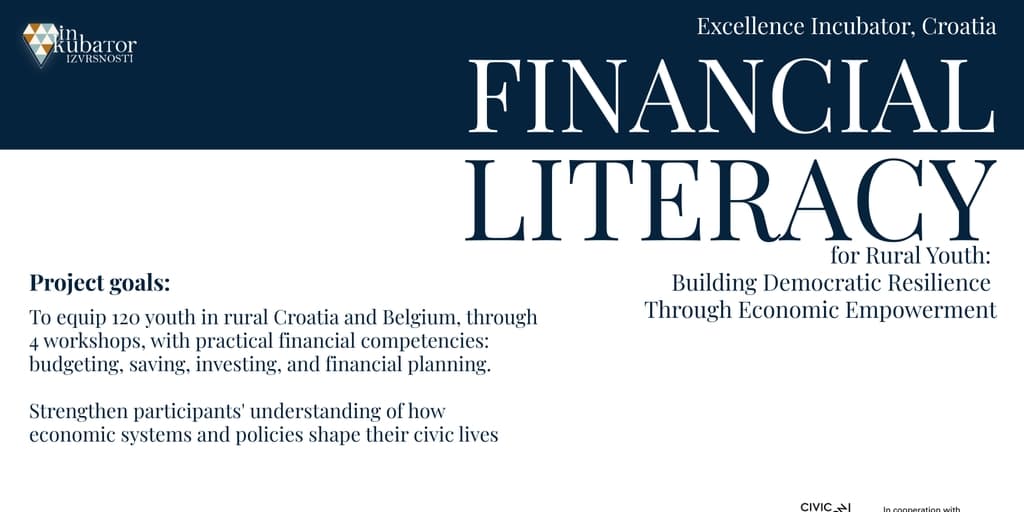
More Than Money: Why Financial Literacy Is a Democratic Competence
Reflections from the Financial and Economic Literacy NECE Lab, Vienna, 27–28 April 2026 When we talk about financial literacy, most people picture budgeting apps, savings accounts, and the fine print on a loan agreement. Useful things, but a narrow picture. Increasingly, educators, researchers, and policymakers across Europe are making a bigger claim: understanding money is not only a personal survival skill. It is a foundation of active citizenship and democratic resilience. That claim was the beating heart of the Financial and Economic Literacy NECE Lab in Vienna, a two-day gathering hosted by THE CIVICS Innovation Hub together with Znanje na djelu and the Erste Financial Life Park (FLiP), with the support of ERSTE Foundation. We were proud to be part of it, having Magdalena Basić Alando actively participate and present our own project, Financial Literacy for Rural Youth, and learning alongside practitioners from across the continent. This post pulls together what the research actually says, and what we saw play out in the room. The problem: too many young people can't apply what they know Start with the evidence. In the OECD's most recent international assessment of 15-year-olds, released in 2024, the picture is sobering: across the 14 OECD countries assessed, 18% of students on average do not have basic proficiency in financial literacy, meaning they cannot apply their knowledge to real-life situations involving financial decisions. The gap is not evenly distributed. Socio-economically disadvantaged students are over-represented among low performers, which risks entrenching inequality as those students become adults. In other words, the young people who most need economic confidence are the ones least likely to be given it — a pattern that maps neatly onto who feels shut out of public life more broadly. There is a hopeful flip side. Financial literacy and positive financial behaviour are linked: students with stronger skills behave more responsibly with money and are more forward-looking, with high performers markedly more likely than low performers to save. Skills, attitudes, and behaviour move together — which is exactly why how we teach matters as much as what we teach. The bigger claim: financial literacy feeds democratic participation Here is where the Vienna conversation went beyond personal finance. One of the Lab's expert speakers was Anna Lo Prete of the University of Turin, whose research sits right at this intersection — and whose work is among the clearest evidence we have on the question. Lo Prete's cross-country analysis documents a positive association between political participation — measured by the number of citizens voting in national elections — and the awareness of the trade-offs behind private and public decisions that basic financial education captures. Crucially, this is not just correlation dressed up: empirical models that control for a large set of other determinants of voter turnout indicate that financial literacy continues to have a positive and causal impact on electoral participation. Why would that be? The logic is intuitive once you see it. Understanding some economics and finance helps citizens grasp the reasons behind public intervention and weigh the pros and cons of policy proposals and agendas. A voter who understands taxation, public budgets, inflation, and debt is simply better equipped to evaluate the promises on a ballot — and harder to mislead. The catch: financial literacy alone isn't enough It would be too easy to conclude "teach kids about compound interest and democracy takes care of itself." The research is more demanding than that — and this nuance came up repeatedly in Vienna's group work. A recurring critique in the academic literature is that much mainstream financial education quietly frames citizens as consumers rather than participants. One influential analysis argues that dominant financial literacy programmes can end up promoting a limited, consumerist form of civic engagement, and that what is really needed is a critical, emancipatory civic financial literacy for an engaged citizenry able to extend and protect more robust conceptions of freedom and democracy. Scholars working on integrative economic education put the point sharply: financial literacy without civic competence remains a merely reactive skill rather than a source of genuine political agency, which is why financial literacy and civic competences should be understood as parts of a single integrative concept of economic education. The two only reach their full value when taught together — money knowledge that can read the system, not just cope with it. Europe is building the scaffolding None of this is happening in a vacuum. The policy architecture is catching up with the research. In 2023 the European Commission and the OECD jointly published a Financial Competence Framework for Children and Youth in the European Union. It is not only about interest rates and risk: alongside the four core content areas — money and transactions, planning and managing finances, risk and reward, and the financial landscape — the framework deliberately integrates cross-cutting dimensions including digital finance, sustainable finance, entrepreneurship, and citizenship. Citizenship is written into the framework by design. On the civic side, the Council of Europe's Reference Framework of Competences for Democratic Culture exists precisely to equip young people with the competences needed to defend and promote human rights, democracy and the rule of law, to act as active citizens, and to live peacefully together with others. Read the two frameworks side by side and the overlap is obvious: critical thinking, informed decision-making, and the confidence to participate. What this looks like in practice: rural youth and economic autonomy This is the gap our own project set out to close, and the reason we were presenting it in Vienna. Financial Literacy for Rural Youth: Building Democratic Resilience Through Economic Empowerment merges financial and civic education for an audience usually left out of both: young people in rural areas, who are systematically underrepresented in programmes that tend to be urban-centred. Working with our partners, the project equips rural GenZ participants in Croatia and Belgium with practical competences: budgeting, saving, investing, planning; through gamified, peer-to-peer, blended learning adapted to rural digital realities. But the design goes a step past personal finance, exactly along the lines the research recommends. Participants learn to analyse economic policies, financial products, and media narratives about money, so they can resist manipulation and make informed civic choices. The premise is that economic dependency and exclusion are themselves barriers to democratic participation, and that when young people understand how taxation, public budgets, and economic policy shape their own lives, they engage more meaningfully in democratic processes. A transnational peer exchange between Croatian and Belgian participants adds a cross-cultural, shared-European dimension, a small counterweight to the polarisation that tends to follow economic marginalisation. The pilot trainings in Croatia are already complete, with workshops in Belgium still ahead. And the methodology is being built to outlast the project and be shared amongst all stakeholders. Where the formal and non-formal worlds meet If there was one moment in Vienna that made the abstract concrete, it was the guided tour of the Erste Financial Life Park (FLiP), FLiP turns financial education into something you can walk through and touch: interactive stations where visitors make real-feeling budgeting decisions and immediately see the consequences. It is a vivid rebuttal to the idea that money education has to be dry. A theme the NECE Lab kept returning to, and one the research underlines, is the relationship between formal schooling and non-formal education. Classrooms provide reach and legitimacy; non-formal initiatives like ours provide the agility to reach underserved groups, experiment with gamified and peer-led methods, and adapt fast. The most promising path forward is not one or the other, but connective tissue between them: school systems that borrow the energy of non-formal approaches, and civic organisations whose toolkits can be picked up and used inside classrooms. The takeaway The case made in Vienna, and backed by the evidence, is straightforward but consequential. Financial literacy is not merely about helping individuals stay solvent. Done well, paired with civic competence rather than reduced to consumer advice, it strengthens people's capacity to understand the systems they live in, to resist manipulation, and to participate in the democratic decisions that shape their economic lives. In an era of rising costs, growing inequality, and declining trust in institutions, that capacity is not a luxury. It is infrastructure for democracy. We left Vienna grateful to all speakers for the intellectual grounding; to our fellow educators for the knowledge exchange and the good company; to the organisers: THE CIVICS Innovation Hub, Znanje na djelu, Erste Financial Life Park, and ERSTE Foundation, FLiP centre. The next chapter is being written in rural classrooms and community halls across Europe. We're glad to be part of it. Sources OECD (2024), PISA 2022 Results (Volume IV): How Financially Smart Are Students?, OECD Publishing. Lo Prete, A. (2024), Political participation and financial education: Understanding personal and collective trade-offs for a better citizenship, Economics Letters / ScienceDirect. Lo Prete, A., Financial education: From better personal finance to improved citizenship, Journal of Financial Literacy and Wellbeing, Cambridge Core. Arthur, C. (2012), Financial Literacy Education for Citizens: What Kind of Responsibility, Equality and Engagement?, Citizenship, Social and Economics Education (SAGE). Integrative Economic Education to Combine Citizenship Education and Financial Literacy (ResearchGate). European Union / OECD (2023), Financial Competence Framework for Children and Youth in the European Union, OECD Publishing. Council of Europe, Reference Framework of Competences for Democratic Culture (RFCDC).
Životni skript: zašto ponavljaš iste obrasce i kako ih promijeniti?
Jesi li ikad primijetio/la da u različitim vezama završavaš s istim tipom problema? Ili da na poslu uvijek ulazi u istu vrstu sukoba --- bez obzira...
